Tidal Energy: How It Works, Types, Benefits, Challenges, Uses, and the Future
Tidal energy is a form of renewable energy that uses the natural movement of seawater caused primarily by the gravitational interaction between the Earth, Moon, and Sun. Unlike solar and wind power, which depend heavily on weather conditions, tidal energy is linked to predictable astronomical cycles. This makes tides an interesting source of renewable electricity for coastal regions, islands, and countries with suitable tidal resources.
Tidal energy can be captured in several ways. Some systems exploit the difference in water levels between high and low tides, while others place underwater turbines in fast-moving tidal currents. The technologies vary considerably in design, environmental footprint, cost, and technological maturity.
Although tidal energy remains much smaller than solar, wind, and conventional hydropower, its predictable nature gives it a potentially useful role in future electricity systems. The International Renewable Energy Agency (IRENA) identifies tidal range and tidal stream as the two major tidal-energy technology categories, while the U.S. Department of Energy classifies tidal resources as part of the broader marine-energy sector.
What Is Tidal Energy?
Tidal energy is energy obtained from the movement or changing level of seawater produced by tides.
The gravitational attraction of the Moon and, to a lesser extent, the Sun causes ocean water to move around the Earth. As the Earth rotates and the relative positions of the Earth, Moon, and Sun change, coastal areas experience periodic high and low tides.
These movements contain energy in two important forms:
- Potential energy, created by differences in water level between high and low tide.
- Kinetic energy, created by the movement of water through tidal currents.
Tidal energy technologies convert one or both forms into electricity.
This makes tidal power different from conventional hydropower. Hydropower generally depends on rivers, dams, reservoirs, and differences in elevation, whereas tidal energy depends on marine water movement associated with tidal cycles.
Tidal resources are especially attractive in areas where large volumes of seawater move through narrow channels, straits, estuaries, or coastal passages.
How Does Tidal Energy Work?
The basic principle is relatively straightforward: moving water turns a mechanical device, and that mechanical movement is converted into electricity.
The exact process depends on the type of tidal technology being used.
Tidal Stream Systems
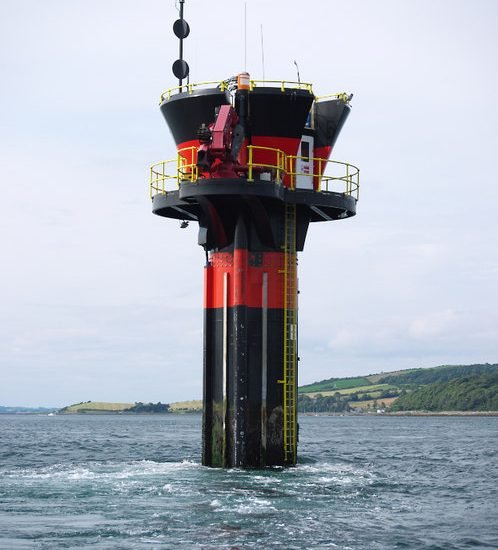
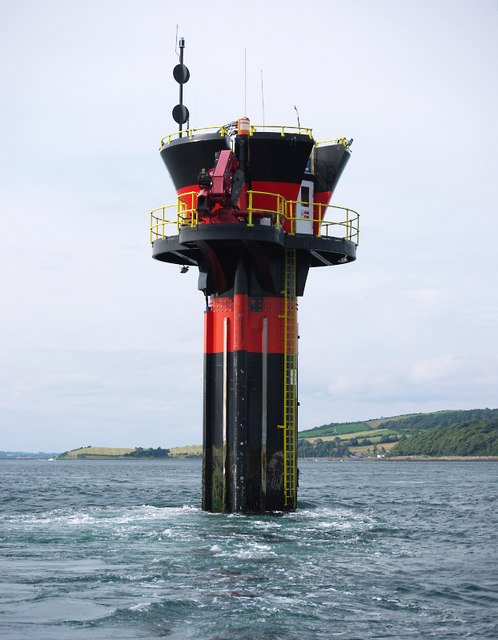
Tidal-stream systems use the kinetic energy of moving seawater.
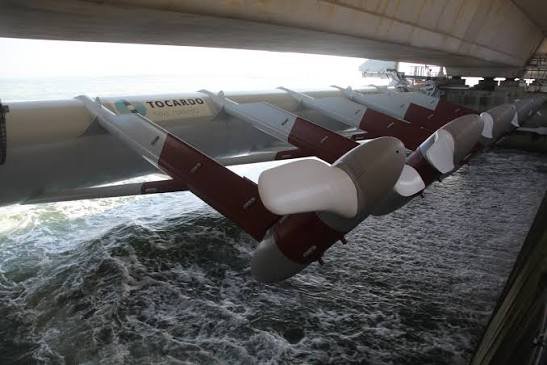
Underwater turbines are installed in locations where tidal currents are sufficiently strong. As water flows past the turbine blades, the blades rotate. The rotor drives a generator, producing electricity.
The electricity is then transferred through subsea cables to an onshore connection point and eventually into the electricity grid or a local power system.
The basic process is:
Tides → moving water → turbine rotation → generator → electricity → grid
Because water is considerably denser than air, tidal currents can contain substantial kinetic energy even when water velocities appear relatively modest compared with wind speeds.
Tidal Range Systems
Tidal-range systems exploit the difference in water level between high and low tides.
A barrage can be constructed across an estuary or bay. Gates and turbines control the movement of water through the structure.
During a tidal cycle, water is allowed to enter or leave the impounded area. The difference in water levels creates a pressure gradient that can drive turbines.
Tidal-range technology is among the most mature ocean-energy technologies. IRENA notes that some tidal barrage plants have operated since the 1960s.
Main Types of Tidal Energy
Tidal energy can be divided into several technology categories.
Tidal Stream or Tidal Current Energy
Tidal-stream turbines resemble underwater wind turbines.
Instead of wind rotating blades in the atmosphere, moving seawater rotates submerged blades.
These systems can be:
- Fixed to the seabed
- Mounted on gravity foundations
- Attached to piles
- Suspended from floating platforms
- Attached to mooring systems
- Designed as underwater tidal kites
Tidal-stream systems are particularly suited to strong tidal-current areas.
Tidal Barrages
A tidal barrage is a large structure built across an estuary or coastal basin.
The barrage creates a controlled difference in water levels. Turbines are installed within the structure, allowing water to pass through them.
One of the best-known examples is the 240 MW La Rance tidal power station in France.
Tidal Lagoons
Tidal lagoons are enclosed coastal areas designed to create an artificial difference in water levels.
Unlike a barrage, which may cross an entire estuary, a lagoon can be constructed using an artificial wall or embankment extending from the coastline.
Water passes through turbines as the tide rises and falls.
Dynamic Tidal Power
Dynamic tidal power is a proposed concept involving very large structures extending from the coast into the sea.
The structure would influence tidal flows and create differences in water levels along its length.
This technology remains far less commercially established than conventional tidal-range systems.
Tidal Kites
Tidal kites are underwater devices attached to a tether.
Instead of remaining stationary like conventional turbines, the kite moves through the water along a predetermined path. This increases the relative velocity between the device and the water, allowing electricity to be generated in locations where conventional turbines might be less effective.
Major Components of a Tidal Stream Power System
A tidal-stream installation can contain several major components.
Turbine Rotor
The rotor consists of blades designed to capture energy from moving water.
Blade geometry is carefully engineered because seawater is dense and imposes significant mechanical loads.
Generator
The generator converts rotational mechanical energy into electrical energy.
Depending on the system design, the generator may be housed inside the turbine nacelle.
Support Structure
The turbine must remain stable in strong underwater currents.
Possible support arrangements include:
- Gravity bases
- Monopiles
- Tripods
- Jackets
- Floating platforms
- Mooring systems
Power Electronics
Power electronics regulate and condition the electricity produced by the turbine before it is transmitted.
Subsea Cable
Electricity travels from the underwater turbine through subsea cables toward shore.
Onshore Substation
The electricity can be transformed and synchronized with the local electricity network at an onshore substation.
Why Are Tides Useful for Electricity Generation?
One of the most important characteristics of tidal energy is predictability.
Tidal cycles can be calculated years in advance because they are strongly related to astronomical movements.
This does not mean tidal electricity production is constant. Output rises and falls as tidal currents change.
However, the timing of these changes is much more predictable than weather-dependent resources such as wind and solar.
This characteristic can potentially help grid planners integrate different renewable resources.
For example, solar power is strongest during daylight hours, while tidal power follows tidal cycles. Combining multiple renewable sources can create a more diversified electricity-generation profile.
Tidal Energy Around the World
Tidal energy remains a relatively small global energy industry compared with solar and wind.
IRENA reports that total installed ocean-energy capacity reached 494 MW globally at the end of 2024. Tidal energy represents a major part of existing ocean-energy capacity, particularly through tidal-range facilities.
Tidal-stream technology is still moving through demonstration and pre-commercial stages.
Ocean Energy Europe reported that European tidal-stream installations remained relatively small in 2024, with one full-scale device and two prototypes deployed during that year. It also reported a pipeline of publicly supported pre-commercial tidal farms.
This illustrates an important distinction: tidal energy exists commercially, but many newer tidal-stream technologies are still scaling toward larger commercial arrays.
Examples of Tidal Energy Projects
La Rance Tidal Power Station
The La Rance facility in France is one of the world’s best-known tidal barrage projects.
It demonstrates that tidal-range electricity generation can operate for decades when supported by suitable geography and infrastructure.
Sihwa Lake Tidal Power Station
South Korea’s Sihwa Lake project is another major tidal-range installation.
It has a generation capacity of 254 MW and is one of the largest tidal power facilities in the world.
MeyGen
MeyGen in Scotland’s Pentland Firth is an important example of tidal-stream development.
The project has demonstrated the use of multiple underwater turbines to generate electricity from strong tidal currents. Scottish Government documentation identifies MeyGen as an operational tidal-energy project, while industry data continues to identify it as a leading tidal-stream development.
Benefits of Tidal Energy
Highly Predictable Generation
Tidal cycles can be forecast accurately.
This is one of tidal energy’s strongest characteristics because electricity planners can estimate when turbines are expected to produce power.
Renewable Resource
Tides are continually produced by astronomical forces.
Unlike fossil fuels, tidal energy does not depend on extracting a finite fuel from underground deposits.
Low Direct Carbon Emissions
Tidal generators do not burn coal, oil, or natural gas during normal electricity generation.
Once a tidal project has been constructed, its operational emissions are generally low.
High Energy Density
Water is much denser than air.
As a result, moving seawater can transfer considerable energy to turbine blades.
This allows tidal devices to generate useful amounts of electricity from relatively compact machines.
Long-Term Resource Availability
The gravitational forces responsible for tides will continue operating on human timescales.
This gives tidal resources a fundamentally renewable character.
Coastal and Island Applications
Tidal systems can potentially support electricity supply in coastal communities and islands where importing diesel fuel is expensive.
IRENA has highlighted ocean energy’s potential for coastal nations and islands and estimates a broader global ocean-energy market potential of around 350 GW by 2050 under its assessed scenario.
Challenges of Tidal Energy
High Capital Costs
Marine construction is expensive.
Developers must install equipment in challenging underwater environments, often requiring specialized vessels, cranes, subsea cables, diving operations, and corrosion-resistant components.
Difficult Maintenance
A tidal turbine may be located underwater in strong currents.
Removing the equipment for maintenance can therefore be considerably more complicated than servicing an onshore wind turbine.
Corrosion
Seawater is highly corrosive.
Marine-energy equipment must be designed to withstand prolonged exposure to saltwater.
Biofouling
Marine organisms can attach themselves to underwater structures.
This can increase maintenance requirements and affect equipment performance.
Limited Suitable Locations
Not every coastline has a commercially attractive tidal resource.
Tidal-stream projects generally require sufficiently strong and consistent currents.
Tidal-range systems require particular coastal geography and substantial differences between high and low water levels.
Environmental Considerations
Tidal developments can alter local water movement and may affect marine habitats.
Potential issues include:
- Changes in sediment transport
- Effects on marine organisms
- Underwater noise
- Collision risks
- Changes to habitats
- Impacts on fisheries
- Changes to navigation
Environmental impacts depend heavily on technology and site.
Research, environmental monitoring, and careful marine spatial planning are therefore important before large-scale development.
Tidal Energy and Marine Life
The environmental question surrounding tidal energy is more complex than simply asking whether turbines are renewable.
A tidal turbine physically occupies part of the marine environment.
Fish, marine mammals, seabirds, benthic organisms, and other species may interact with infrastructure or experience changes in local hydrodynamics.
At the same time, the actual effects vary substantially according to turbine design, location, speed of currents, biological communities, and project size.
This is why environmental impact assessments are important before commercial deployment.
Tidal Energy vs Wind and Solar
Tidal, wind, and solar energy all produce renewable electricity, but their operating characteristics differ.
| Feature | Tidal | Wind | Solar |
|---|---|---|---|
| Main resource | Ocean tides/currents | Moving air | Sunlight |
| Predictability | Very high | Variable | Highly predictable by time of day |
| Fuel cost | None | None | None |
| Location constraints | Strong | Moderate to strong | Moderate |
| Marine environment | Yes | Usually no | No |
| Technology maturity | Mixed | High | High |
| Maintenance environment | Difficult offshore/subsea | Onshore/offshore | Usually accessible |
| Night generation | Possible | Possible | No |
| Weather dependence | Low direct dependence | High | High |
The comparison does not establish that one technology is universally preferable. Each technology is suited to different geographical and electricity-system conditions.
Tidal Energy and Energy Storage
Because tidal output follows a predictable cycle, storage can be used to help align electricity generation with demand.
Possible technologies include:
- Batteries
- Pumped-storage hydropower
- Hydrogen production
- Thermal storage
- Grid-scale storage systems
Storage may become increasingly relevant if tidal farms are deployed alongside other variable renewable resources.
Tidal Energy for Islands
Island communities often face high electricity costs because conventional fuels must be imported.
Tidal energy could provide a locally available source of electricity where strong tidal currents exist.
This is particularly interesting for islands that already have:
- High diesel dependence
- Strong tidal resources
- Limited land
- High fuel transportation costs
- Small electricity grids
However, the economics still depend on installation, maintenance, grid connection, and financing costs.
Tidal Energy in Developing Countries
Many developing countries have long coastlines and substantial marine resources.
Africa, Asia, Latin America, and small island states contain coastal areas that could potentially support marine renewable energy.
However, technical resource availability does not automatically mean that a project is economically viable.
Projects need:
- Suitable tidal conditions
- Grid infrastructure
- Financing
- Port facilities
- Skilled workers
- Marine engineering capability
- Environmental approvals
- Long-term revenue arrangements
For countries with weak grids, small tidal projects could potentially be considered for isolated coastal systems, but the feasibility must be assessed site by site.
The Economics of Tidal Energy
The cost of tidal electricity is influenced by several factors.
Construction
Marine foundations, turbines, cables, vessels, and offshore installation can represent major costs.
Operations and Maintenance
Routine maintenance can be more expensive than for many land-based renewable technologies.
Financing
Because tidal-stream technology is less mature than solar and wind, investors may perceive greater technical and commercial risk.
Economies of Scale
Larger tidal farms may reduce the cost per unit of electricity by spreading infrastructure and operational costs across more turbines.
IRENA and Ocean Energy Europe have identified financing, market visibility, and revenue support as recurring challenges for scaling ocean-energy technologies.
The Future of Tidal Energy
The future of tidal energy is likely to involve continued technology development rather than immediate replacement of established renewable technologies.
Research is focusing on:
- Larger turbines
- More reliable generators
- Improved underwater materials
- Floating tidal platforms
- Tidal kites
- Better subsea cables
- Automated inspection
- Remote monitoring
- Predictive maintenance
- Improved environmental monitoring
- Larger tidal arrays
Artificial intelligence and advanced sensors may also help operators identify mechanical problems before they become major failures.
Tidal Energy and the Blue Economy
Tidal energy can become part of a broader blue-economy strategy.
Ports, shipbuilding companies, marine engineering firms, subsea-service companies, universities, fisheries, and coastal communities can all interact with marine-energy development.
If the sector expands, it could create demand for specialized manufacturing and engineering capabilities.
However, these opportunities need to be balanced against other marine uses, including fishing, shipping, tourism, conservation, and aquaculture.
Frequently Asked Questions About Tidal Energy
Is tidal energy renewable?
Yes. Tidal energy is renewable because tides are continuously produced by gravitational interactions involving the Earth, Moon, and Sun.
How does a tidal turbine generate electricity?
Moving seawater rotates turbine blades. The rotor transfers mechanical energy to a generator, which converts that energy into electricity.
Is tidal energy predictable?
Yes. Tidal cycles are highly predictable because they are governed primarily by astronomical forces. However, electricity output still varies during each tidal cycle.
Is tidal energy the same as wave energy?
No. Tidal energy uses tidal water-level changes or tidal currents, while wave energy captures energy from ocean waves.
Does tidal energy produce greenhouse gases?
Tidal turbines do not burn fuel during operation, so their direct operational greenhouse-gas emissions are very low. Construction, transportation, installation, maintenance, and decommissioning still have environmental footprints.
What are the biggest disadvantages of tidal energy?
The major challenges include high capital costs, difficult marine maintenance, corrosion, limited suitable sites, subsea infrastructure requirements, and potential environmental effects.
Can tidal energy replace solar and wind?
Tidal energy is generally better considered a complementary renewable resource rather than a universal replacement for other renewable technologies. Its usefulness depends strongly on local tidal conditions and project economics.
What is tidal-range energy?
Tidal-range energy uses differences in water levels between high and low tides, usually with barrages or lagoon-like structures.
What is tidal-stream energy?
Tidal-stream energy uses underwater turbines or other devices to capture the kinetic energy of moving tidal currents.
Where is tidal energy most suitable?
It is most suitable in coastal areas with strong tidal ranges or fast tidal currents, combined with suitable grid access, marine infrastructure, environmental conditions, and economic factors.
Conclusion
Tidal energy is a renewable marine-energy technology that converts the movement of ocean tides into electricity. Its greatest distinguishing characteristic is predictability: unlike wind and solar resources, tidal cycles can be forecast far in advance.
The sector includes mature tidal-range technologies such as barrages as well as newer tidal-stream technologies using underwater turbines, floating devices, and tidal kites. Existing projects demonstrate that tidal power can generate electricity, but the broader tidal-stream industry is still working toward greater commercial scale.
The technology faces significant challenges, including high capital costs, difficult offshore maintenance, corrosion, environmental considerations, and the limited number of locations with suitable tidal resources. Nevertheless, its predictable generation profile and high energy density make tidal energy an interesting component of a diversified renewable electricity system.
For readers researching tidal power further, authoritative information is available from IRENA’s Tidal Energy technology brief, IRENA’s Ocean Energy resources, the U.S. Department of Energy’s Marine Energy Basics, and Ocean Energy Europe’s sector statistics.
You may also like
Leave a Reply