Valve Steam Frame: Features, Specifications, How It Works, Games, Price, and the Future of VR Gaming

Valve Steam Frame is a new standalone virtual reality headset designed around a simple but ambitious idea: bring the Steam gaming ecosystem into a wireless headset that can run some games locally while also providing high-quality wireless PC VR streaming.
Valve first unveiled Steam Frame in November 2025 as part of a new generation of Steam hardware. At launch, the company positioned it as a “streaming-first” device rather than a conventional standalone VR headset. By September 2026, Valve had revealed the final pricing, storage options, accessories, reservation system, and a major software development: a native standalone version of Half-Life: Alyx.
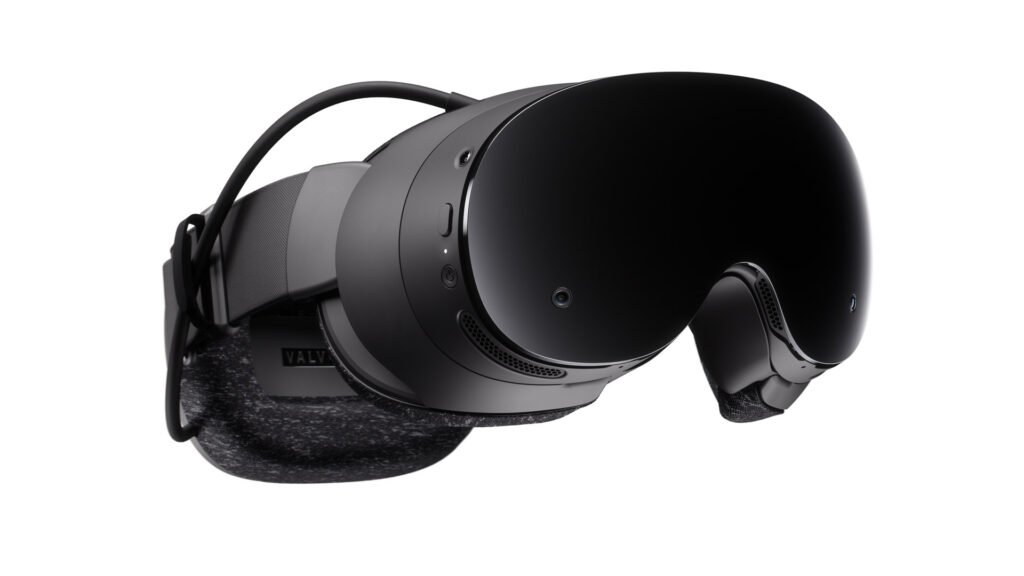

The Steam Frame runs a VR-adapted version of SteamOS and uses a Qualcomm Snapdragon 8 Gen 3 processor with 16GB of memory. It features dual 2160 × 2160 LCD displays, pancake lenses, eye tracking, inside-out tracking, Wi-Fi 7, and a dedicated wireless adapter for low-latency PC streaming. It also supports both VR games and traditional flat-screen Steam games.
Table of Contents
Unlike Valve’s earlier Index headset, Steam Frame does not depend on external base stations or a wired DisplayPort connection. Instead, it is designed to provide a more portable and self-contained Steam gaming experience.
What Is Valve Steam Frame?
Valve Steam Frame is a standalone VR gaming headset developed by Valve, the company behind Steam, Steam Deck, SteamOS, and the Valve Index.
The headset combines three major functions.
First, it can operate as a standalone VR gaming device. Its Snapdragon processor provides enough computing power to run compatible games directly on the headset.
Second, it can run traditional non-VR Steam games locally when they are compatible with its hardware and software environment. This makes Steam Frame different from VR headsets that are primarily designed around a dedicated VR application store.
Third, Steam Frame can wirelessly stream PC VR and traditional PC games from a more powerful computer. Valve includes a dedicated wireless adapter intended to establish a low-latency connection between the gaming PC and the headset.
This hybrid approach is central to the Steam Frame concept. Instead of requiring every demanding game to run on the headset itself, the device can use a nearby PC when additional processing power is necessary.
Valve Steam Frame Specifications
The main specifications of Steam Frame include:
| Feature | Steam Frame |
|---|---|
| Processor | Qualcomm Snapdragon 8 Gen 3 |
| Architecture | ARM64 |
| RAM | 16GB LPDDR5X |
| Storage | 256GB or 1TB |
| Expandable storage | microSD |
| Display | Dual LCD |
| Resolution | 2160 × 2160 per eye |
| Refresh rate | 72–144Hz, with 144Hz experimental |
| Optics | Pancake lenses |
| Field of view | Up to approximately 110° |
| Operating system | SteamOS |
| Tracking | Inside-out |
| Tracking cameras | Four external monochrome cameras |
| Eye tracking | Two internal cameras |
| Wireless | Wi-Fi 7 |
| PC streaming | Dedicated 6GHz Wi-Fi 6E adapter |
| Battery | 21.6Wh rechargeable battery |
| Charging | USB-C, up to 45W |
| Audio | Integrated dual-driver speakers |
| Controllers | Steam Frame Controllers |
| Controller power | Replaceable AA batteries |
| Headset weight | Approximately 440g with headstrap and facial interface |
| Core headset weight | Approximately 185g |
| Storage expansion | microSD card |
The specifications reflect Valve’s announced hardware and launch information, although some details such as real-world battery duration can vary significantly depending on whether games are rendered locally or streamed from a PC.
Design and Build
Steam Frame takes a different physical approach from the older Valve Index.
The headset is designed around a modular structure, with the main computing module separated from the rear-mounted battery and head strap. This arrangement helps distribute weight instead of placing the entire electronic system directly in front of the user’s face.
The core headset weighs roughly 185 grams, while the complete assembly with the head strap and other components is around 440 grams according to published specifications and testing.
This relatively balanced construction is important because VR headsets can become uncomfortable when too much weight is concentrated at the front.
The headset also uses a facial interface and adjustable components designed to accommodate different users. Valve offers an optional Ergonomic Accessories Kit containing an additional top strap, controller hand straps, battery doors for the controller straps, and an extended light blocker.
Pancake Lenses and Visual Experience
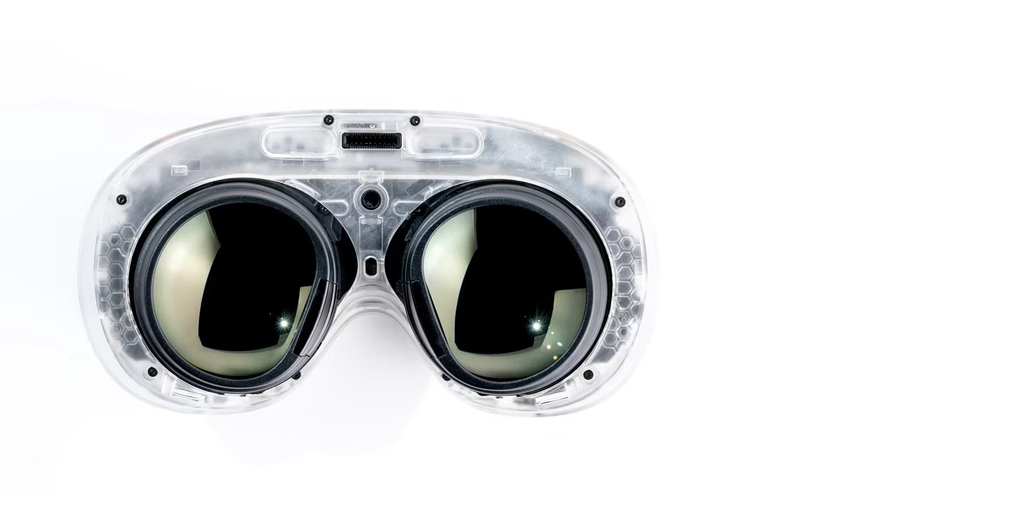
Steam Frame uses multi-element pancake lenses instead of the fresnel lenses used by the original Valve Index.
Pancake optics have become increasingly common in modern VR headsets because they can provide a relatively thin optical system while maintaining a large usable viewing area.
Steam Frame has two LCD panels, each providing a resolution of 2160 × 2160 pixels. That produces more than 4.6 million pixels per eye. The headset supports refresh rates ranging from 72Hz to 144Hz, although 144Hz is identified as an experimental mode.
The headset’s field of view is approximately 110 degrees horizontally, giving users a broad view of virtual environments.
A manual adjustment mechanism allows users to alter lens separation to match their interpupillary distance, helping improve visual alignment.
Eye Tracking and Foveated Streaming
One of Steam Frame’s most important technologies is eye tracking.
Two internal cameras monitor the user’s eyes. The system can determine where the user is looking and use that information to improve wireless VR streaming.
This enables a technique called foveated streaming.
Human vision is most sensitive to detail in the area directly being viewed. Peripheral vision generally requires less visual detail.
A conventional streaming system could therefore waste bandwidth sending maximum-quality imagery to every part of the display. Foveated streaming instead prioritizes the region where the user is looking.
Valve uses eye tracking to help send greater visual detail toward the user’s focal area while reducing unnecessary data elsewhere. This can help reduce the bandwidth requirements of wireless PC VR.
For a headset that emphasizes wireless streaming, this is particularly important.
Inside-Out Tracking
Steam Frame does not require external base stations.
Instead, it uses cameras mounted on the headset to track the headset’s position and movement within its surroundings.
This is known as inside-out tracking.
The headset contains four outward-facing monochrome cameras used for tracking. The system also uses internal cameras for eye tracking. Infrared illumination assists tracking in darker environments.
The advantage is convenience.
Users do not need to install tracking stations around a room before playing. This makes the headset easier to move between rooms and locations.
The Steam Frame controllers are tracked by the headset as well, allowing six-degrees-of-freedom interaction.
Monochrome Passthrough Instead of Color Passthrough
One important distinction between Steam Frame and some competing modern mixed-reality headsets is its approach to passthrough.
Steam Frame’s built-in passthrough is monochrome rather than full-color.
The headset can show the physical environment through its external cameras, but the view is grayscale rather than a high-quality RGB representation. UploadVR reported that the out-of-the-box passthrough is significantly less detailed and lacks the color passthrough found on devices such as Meta Quest 3.
This means Steam Frame is primarily designed around VR gaming and wireless PC gaming rather than high-end mixed-reality applications.
Valve has nevertheless supported an expansion path.
Optional Color Passthrough Camera
Valve has partnered with Arcturus Vision on an optional camera accessory.
The Arcturus Vision Camera attaches to Steam Frame’s expansion interface and adds color passthrough capabilities. According to UploadVR, the accessory uses two 32-megapixel Sony RGB sensors and can capture high-resolution stereo footage. It is priced at $149 in the United States.
This modular approach gives users a choice.
People primarily interested in VR gaming can use the headset without the additional camera, while users interested in spatial video and color passthrough can add the accessory.
The expansion concept is also significant because it suggests Valve is treating Steam Frame as a platform that can evolve through hardware accessories rather than as a completely fixed headset.
Snapdragon 8 Gen 3 Performance
Steam Frame is powered by Qualcomm’s Snapdragon 8 Gen 3 mobile processor.
This is an ARM-based chip manufactured using a 4nm process and paired with 16GB of LPDDR5X memory.
The processor provides the computing foundation for standalone applications.
However, Steam Frame should not be understood as equivalent to a modern gaming desktop. Mobile processors consume far less power than desktop GPUs, but they also have substantially different performance characteristics.
This is why Valve’s wireless PC streaming strategy is so important.
When the headset is connected to a capable gaming PC, demanding graphics can be rendered by the computer and transmitted to Steam Frame.
When running locally, games need to be compatible with the headset’s ARM hardware and available processing resources.
SteamOS on Steam Frame
Steam Frame runs SteamOS, the Linux-based operating system Valve also uses as the foundation of Steam Deck and Steam Machine.
For Steam Frame, Valve has adapted SteamOS for VR.
The operating system is designed to provide access to Steam content while handling VR-specific hardware, tracking, input and streaming functions.
Valve also uses compatibility technologies to make software built for different architectures and operating systems more accessible.
According to UploadVR, Windows games can use Proton for compatibility while FEX can translate x86 code for the ARM processor. Android applications can use a separate compatibility layer known as Lepton.
This creates a potentially broad software environment.
Instead of requiring every game to be specifically rebuilt from scratch for Steam Frame, Valve’s software stack can provide compatibility mechanisms that allow different categories of software to operate on the device.
Playing Steam Games Without a PC
One of the most interesting features of Steam Frame is that it can operate without a gaming PC.
The Snapdragon processor allows compatible titles to run locally.
Valve has also confirmed a native ARM version of Half-Life: Alyx, one of the most technically significant VR games in the Steam ecosystem. The game is included with Steam Frame for customers who do not already own it.
Valve says the standalone version uses eye-tracked foveated rendering along with extensive Vulkan graphics-driver and SteamVR optimizations.
Importantly, Valve said the standalone version did not require changes to the game’s content, meaning Workshop items can continue to work and Steam Cloud saves allow users to switch between standalone play and PC streaming.
This is a major demonstration of what the hardware can achieve locally.
Steam Frame Verified Games
Valve has also established a Steam Frame Verified category for games that have been tested and confirmed to perform well in standalone mode.
At launch, Valve had confirmed 70 VR titles under this designation, including games such as Beat Saber, Arizona Sunshine VR 2, Pistol Whip, SUPERHOT VR, Moss, Red Matter 2, Walkabout Mini Golf VR, VAIL and others.
This is important because a huge Steam library does not automatically mean that every title will perform equally well on a mobile ARM processor.
The Verified system provides users with a clearer indication of which VR games have been tested specifically for the hardware.
Wireless PC VR Streaming
PC VR streaming is arguably the defining feature of Steam Frame.
Instead of connecting the headset to a computer using a DisplayPort cable, Valve uses wireless networking.
The included adapter establishes a direct 6GHz Wi-Fi 6E connection between the PC and headset. The system can also use the user’s local wireless network.
This approach provides a significant practical benefit: freedom from a cable.
A VR cable can become a physical limitation during room-scale games because users can step on it, pull it or become tangled in it.
Wireless streaming removes that connection.
Multi-Link Streaming
Valve has added another technology called Multi-Link Streaming.
The system can use the dedicated adapter and the local Wi-Fi network simultaneously, selecting the lower-latency connection on a packet-by-packet basis.
The goal is greater stability during wireless PC VR.
Valve has also implemented PC-side contrast adaptive sharpening to improve the appearance of streamed imagery.
Together with foveated streaming, these technologies show how heavily Valve is investing in wireless transmission rather than traditional wired VR.
Steam Frame Controllers
Steam Frame comes with two tracked controllers.
The controllers provide six-degrees-of-freedom tracking and include inertial measurement hardware, capacitive finger sensing, haptic feedback and magnetic TMR thumbsticks.
They are also designed with traditional gamepad-style controls.
This is particularly relevant because Steam Frame supports both VR games and ordinary flat-screen games.
Traditional Steam titles need conventional controls such as sticks, buttons and triggers, while VR applications require motion tracking and positional input.
Valve’s controller design attempts to bridge those two worlds.
Each controller uses a replaceable AA battery, with Valve’s stated target around 40 hours of controller use.
Audio and Microphones
Steam Frame incorporates its audio hardware into the head strap.
The headset uses dual speaker drivers per ear, providing stereo sound without requiring traditional headphones.
Integrated audio is useful for VR because it keeps the user immersed without adding another device to the head.
The headset also contains a microphone array for voice communication, multiplayer gaming and other applications that require audio input.
Battery and Charging
Steam Frame uses a 21.6Wh rechargeable lithium-ion battery.
Charging is handled through USB-C, with support for up to 45W charging according to published specifications.
Actual battery life depends heavily on how the headset is being used.
Standalone rendering can place significant demands on the mobile processor and graphics hardware, while wireless streaming changes where much of the rendering workload occurs.
Recent independent testing has reported roughly one to several hours depending on usage, illustrating why published real-world battery figures should be treated as workload-dependent rather than as a single universal number.
The ability to use USB-C power while operating the headset also gives users another option for longer sessions.
Storage Options
Valve offers Steam Frame in two internal storage configurations:
- 256GB
- 1TB
The 256GB version is aimed at users who may rely heavily on streaming, while the 1TB model provides substantially more room for locally installed games and applications.
Steam Frame also includes a microSD card slot, giving users an additional way to expand storage.
This is particularly useful for a Steam-oriented device because modern games can consume tens or even hundreds of gigabytes.
Steam Frame Price
Valve has announced two primary Steam Frame configurations.
The 256GB model costs $1,059 in the United States.
The 1TB model costs $1,299.
Both configurations include the headset, tracked controllers and wireless adapter.
Regional launch pricing reported by Road to VR included €1,049 for the 256GB version and €1,279 for the 1TB model, while UK pricing was £889 and £1,089 respectively.
Valve also sells accessories separately.
The Ergonomic Accessories Kit is priced at $59, while a replacement accessory kit costs $49. Valve’s USB-C power supply is sold separately for $29.
Steam Frame Availability and Reservations
Steam Frame availability has been handled differently from a conventional first-come, first-served product launch.
Valve used a reservation system with randomized queue placement for the initial allocation. Customers selected their desired storage configuration, after which Valve randomized reservations to determine the initial purchase queue.
The approach was intended in part to manage limited initial supply and reduce reseller activity.
Because availability can change as Valve produces additional units, buyers should check the official Steam store for the latest regional availability rather than relying on older launch announcements.
Steam Frame Compared With Valve Index
Steam Frame represents a major architectural change from the Valve Index.
The Index is a PC-dependent VR headset that uses a wired connection and external Lighthouse base stations.
Steam Frame eliminates those requirements.
It has:
- Standalone processing
- Inside-out tracking
- Wireless PC streaming
- SteamOS
- Eye tracking
- Pancake lenses
- Higher-resolution displays
- A rechargeable rear-mounted battery
- Steam Frame Controllers
The result is a more portable system that can work independently while retaining the ability to use PC hardware for demanding VR games.
Steam Frame Compared With Meta Quest
Steam Frame and Meta Quest headsets share an important characteristic: both can operate without a gaming PC.
However, their software strategies differ.
Meta’s Quest ecosystem is built around Meta’s Horizon platform and Android-based software environment.
Steam Frame is built around SteamOS and the Steam ecosystem.
Steam Frame also places unusually strong emphasis on wireless PC VR streaming. Its dedicated wireless adapter is intended to create a direct, low-latency connection to a gaming PC.
Another difference is passthrough.
Quest 3 provides color passthrough through RGB cameras, whereas Steam Frame’s integrated passthrough is monochrome. Valve’s color passthrough capability is available through an optional third-party camera accessory.
Steam Frame and Mixed Reality
Steam Frame can technically provide a view of the surrounding environment, but mixed reality is not its primary design emphasis.
Its standard cameras are primarily associated with tracking, while built-in passthrough is monochrome.
This contrasts with headsets that make full-color spatial computing a central part of their identity.
Nevertheless, the optional Arcturus camera creates a path toward more advanced spatial applications.
It can add color passthrough and support stereo video capture, potentially expanding Steam Frame beyond conventional VR gaming.
Steam Frame for Traditional Games
Steam Frame is not limited to VR.
Valve designed it to support traditional Steam games as well.
A normal PC game can appear as a large virtual screen inside the headset, allowing users to play conventional games without occupying a physical monitor.
This could make Steam Frame useful for portable gaming in situations where carrying a large display is inconvenient.
The system can also stream demanding traditional PC games from a computer.
In that respect, Steam Frame combines characteristics of a VR headset, portable gaming device and wireless PC display.
Steam Frame for PC Gaming
When connected to a capable PC, Steam Frame can access the much larger performance capabilities of desktop hardware.
This makes it possible to stream demanding Steam games that would be too intensive for the headset’s Snapdragon processor.
For VR gaming, the dedicated wireless connection is especially important because latency and consistency can strongly influence comfort and responsiveness.
The objective is to make the user experience resemble a conventional PC VR connection while removing the physical cable.
Steam Frame for Developers
Steam Frame could also have implications for VR developers.
Because the device uses SteamOS and supports multiple compatibility layers, developers have an opportunity to distribute applications through the existing Steam ecosystem.
At the same time, standalone performance requirements mean developers need to consider the limitations of mobile hardware when optimizing native applications.
The Steam Frame Verified program can potentially make this easier for consumers by identifying software that has been tested specifically on the device.
Benefits of Steam Frame
Wireless PC VR
The dedicated wireless adapter eliminates the need for a physical video cable between the headset and PC.
Standalone Gaming
Compatible VR and traditional games can run directly on the headset without a gaming PC.
Steam Ecosystem
The device is built around Steam, giving it access to an established PC gaming ecosystem.
High-Resolution Displays
The dual 2160 × 2160 LCD panels provide a high-resolution image for VR applications.
Pancake Optics
Pancake lenses provide a compact optical system and a large usable viewing area.
Eye Tracking
Eye tracking enables foveated streaming and can reduce the amount of bandwidth required for high-quality wireless PC VR.
Expandable Storage
The microSD slot gives users additional storage flexibility.
Modular Hardware
The accessory and expansion approach gives Valve and third-party developers room to extend the device.
Traditional and VR Games
The ability to play both VR and non-VR Steam games gives Steam Frame a broader role than a headset dedicated exclusively to immersive applications.
Limitations and Challenges
High Launch Price
The $1,059 starting price places Steam Frame firmly in the premium VR category.
Battery Constraints
Like other mobile VR devices, Steam Frame has limited energy capacity compared with a conventional desktop computer.
Monochrome Built-In Passthrough
The integrated passthrough system does not provide the full-color experience available on some competing mixed-reality headsets.
Standalone Performance
The Snapdragon 8 Gen 3 is powerful for a mobile platform, but demanding PC-level games still benefit from streaming from a more capable computer.
Limited Native VR Selection
Valve has confirmed a group of Steam Frame Verified titles, but the long-term success of the platform will depend partly on developers continuing to support standalone VR.
Accessories Add Cost
Some accessories, including the power supply and ergonomic kit, are sold separately.
Who Is Steam Frame Designed For?
Steam Frame is primarily aimed at people who want access to the Steam ecosystem through a wireless VR device.
It can appeal to several groups.
PC VR gamers can use the dedicated wireless connection to stream demanding games.
Steam users can access compatible flat-screen and VR titles.
VR enthusiasts can experiment with standalone SteamOS gaming.
Portable gamers can use the headset as a virtual display for conventional games.
Developers and enthusiasts may be interested in the Linux-based operating system, compatibility layers and modular hardware.
It is less directly focused on consumers whose primary interest is high-end mixed reality, because its built-in passthrough is monochrome and its main emphasis is gaming.
The Future of Steam Frame
The most interesting part of Steam Frame may be its software and hardware flexibility.
Valve is not treating the device purely as a closed VR console.
The combination of SteamOS, ARM compatibility, Proton, FEX, Lepton, wireless PC streaming and modular expansion creates a broader platform.
The company has already demonstrated that technically demanding VR software can be adapted for standalone operation through the native Half-Life: Alyx build. Valve says the game uses eye-tracked foveated rendering, Vulkan optimization and other changes to make standalone operation possible.
Future developments could therefore focus on improving standalone game compatibility, expanding Steam Frame Verified titles, improving wireless streaming and adding new accessories.
The optional color camera also provides a potential path into more advanced mixed-reality and spatial-video applications.
Frequently Asked Questions About Valve Steam Frame
What is Valve Steam Frame?
Valve Steam Frame is a standalone VR headset designed to run compatible Steam games locally and stream VR or traditional PC games wirelessly from a computer.
Is Steam Frame standalone?
Yes. Steam Frame has its own Snapdragon 8 Gen 3 processor, 16GB of memory and SteamOS, allowing compatible games to run without a PC.
Does Steam Frame require a PC?
No. A PC is not required for compatible standalone games. However, a gaming PC can provide access to more demanding PC VR and traditional Steam titles through wireless streaming.
What processor does Steam Frame use?
Steam Frame uses Qualcomm’s Snapdragon 8 Gen 3 processor with an ARM64 architecture.
How much RAM does Steam Frame have?
Steam Frame has 16GB of LPDDR5X memory.
What is the Steam Frame display resolution?
The headset uses dual LCD panels with 2160 × 2160 pixels per eye.
What refresh rate does Steam Frame support?
Steam Frame supports refresh rates from 72Hz to 144Hz, with 144Hz designated as an experimental mode.
Does Steam Frame have eye tracking?
Yes. Two internal cameras provide eye tracking, which is also used for foveated wireless streaming.
Does Steam Frame have color passthrough?
Not through its standard built-in cameras. Steam Frame’s integrated passthrough is monochrome. A separate Arcturus Vision Camera can add color passthrough.
How much does Steam Frame cost?
The 256GB model starts at $1,059, while the 1TB version starts at $1,299 in the United States.
Does Steam Frame include controllers?
Yes. Both storage configurations include tracked Steam Frame Controllers.
Does Steam Frame include a charger?
The headset supports USB-C charging, but Valve sells its own power supply separately. The Valve-branded PSU is listed at $29 in the United States.
Can Steam Frame play Half-Life: Alyx?
Yes. Valve has developed a native ARM version of Half-Life: Alyx for Steam Frame, and the game is included with the headset for customers who do not already own it.
Can Steam Frame play normal PC games?
Yes. Steam Frame supports traditional flat-screen Steam games and can also stream them from a PC.
Does Steam Frame use base stations?
No. It uses inside-out tracking through cameras mounted on the headset.
Does Steam Frame replace Valve Index?
Steam Frame represents Valve’s next major VR hardware platform after Index, but it changes the design philosophy substantially by emphasizing standalone operation and wireless PC streaming.
Conclusion
Valve Steam Frame represents a different direction for PC-connected virtual reality. Rather than simply creating another wired successor to the Valve Index, Valve has built a standalone SteamOS headset that combines local gaming, traditional Steam games, wireless PC VR streaming, eye tracking and a modular hardware architecture. Its Snapdragon 8 Gen 3 processor, 16GB of memory, dual 2160 × 2160 displays, pancake optics, Wi-Fi 7 and dedicated 6GHz PC streaming adapter form the foundation of the system.
The launch configuration includes 256GB and 1TB storage options, with prices beginning at $1,059. Valve has also confirmed a native standalone version of Half-Life: Alyx, a Steam Frame Verified program covering dozens of VR titles, and an ecosystem of accessories including an optional color passthrough camera.
For readers researching Steam Frame specifications, features, games, price, standalone VR capabilities and wireless PC gaming, the most useful primary reference is Valve’s Steam hardware information on Steam, supplemented by current technical reporting from UploadVR and Road to VR.