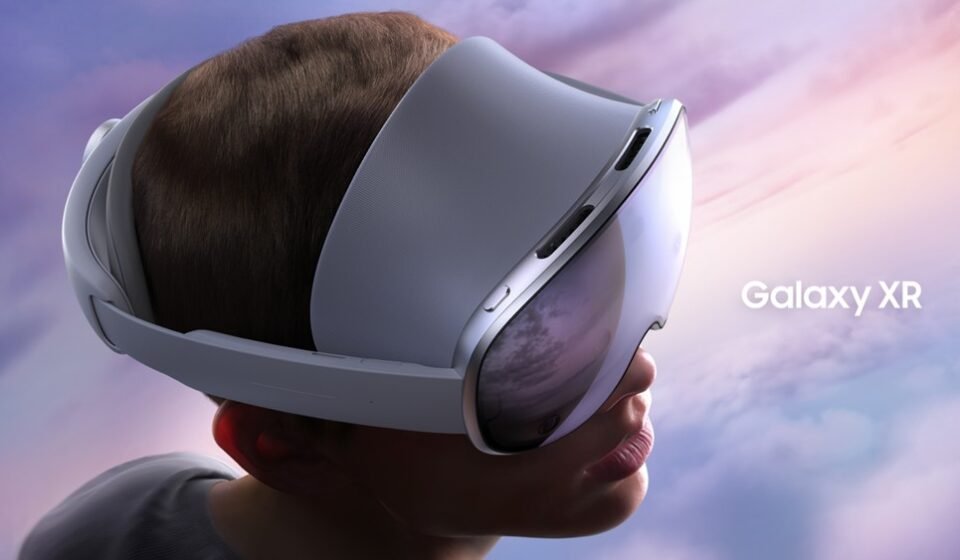

Samsung Galaxy XR is a mixed-reality headset designed to combine virtual reality, augmented reality, spatial computing and multimodal artificial intelligence in a single wearable device.
Introduced by Samsung in October 2025, Galaxy XR is the first commercial device built on Google’s Android XR platform, developed jointly by Samsung, Google and Qualcomm. Rather than positioning the headset only as a gaming device, the companies designed it around a broader range of activities, including entertainment, productivity, exploration, communication and AI-assisted interaction.

Galaxy XR combines high-resolution Micro-OLED displays, eye tracking, hand tracking, environmental cameras, depth sensing, spatial audio and the Snapdragon XR2+ Gen 2 platform. It also places Google’s Gemini AI at the center of the user experience, allowing users to interact with the system through voice, vision and gestures.
Table of Contents
This makes Galaxy XR different from traditional virtual-reality headsets. Instead of completely separating users from the physical world, the device can show digital content alongside the user’s surroundings. Users can also switch into fully immersive virtual environments when an application or experience calls for it.
What Is Samsung Galaxy XR?
Samsung Galaxy XR is an extended-reality headset running Android XR and Samsung’s One UI XR software environment.
Extended reality, or XR, is an umbrella term covering technologies such as virtual reality, augmented reality and mixed reality.
Galaxy XR can therefore operate across several types of experiences.
In a fully immersive experience, the headset can replace the user’s surroundings with a virtual environment.
In mixed reality, digital objects, applications and information can appear within the physical environment.
In productivity applications, virtual screens can be positioned around the user to create an expanded digital workspace.
Samsung describes Galaxy XR as an AI-native device designed around multimodal interaction, meaning that it can combine information from the user’s voice, vision, gestures and surrounding environment.
Galaxy XR Specifications
Samsung’s published specifications include:
- 16 GB RAM
- 256 GB storage
- Micro-OLED display
- 3,552 × 3,840 resolution
- Approximately 27 million pixels
- 6.3-micron pixel pitch
- 95% DCI-P3 color gamut
- 60 Hz, 72 Hz and up to 90 Hz refresh rates
- 109-degree horizontal field of view
- 100-degree vertical field of view
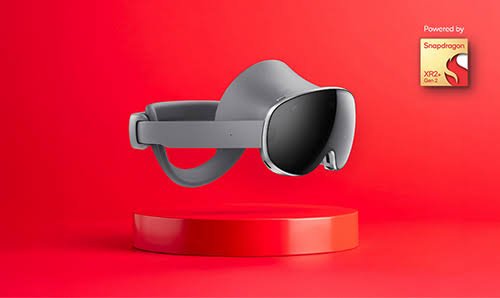
- Snapdragon XR2+ Gen 2 platform
- Two high-resolution passthrough cameras
- Six world-facing tracking cameras
- Four eye-tracking cameras
- Five inertial measurement units
- One depth sensor
- One flicker sensor
- Iris recognition
- Two two-way speakers
- Six-microphone array
- Wi-Fi 7
- Bluetooth 5.4
- 54–70 mm IPD range
- Up to two hours of general use
- Up to 2.5 hours of video playback
- Approximately 545-gram headset weight
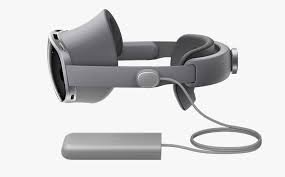
- Separate 302-gram battery
The exact experience can vary depending on software, applications, settings and accessories.
How Does Galaxy XR Work?
Galaxy XR combines cameras, sensors, processors and displays to understand the user’s movements and surroundings.
The system continuously gathers information about the physical environment and the user’s position.
That information is then used to determine where virtual objects, windows and other digital elements should appear.
Environmental tracking
The headset uses multiple outward-facing cameras and a depth sensor to understand its surroundings.
This allows applications to recognize physical spaces and place virtual content within them.
Eye tracking
Four dedicated eye-tracking cameras monitor the user’s eyes.
Eye tracking allows users to select interface elements simply by looking at them.
It can also support more efficient rendering by concentrating graphical resources on the area where the user is looking.
Hand tracking
Galaxy XR can recognize hand movements, allowing users to interact with digital content without always needing physical controllers.
Users can use gestures to select, manipulate and interact with virtual objects.
Voice interaction
Voice provides another major input method.
Instead of navigating every function manually, users can communicate with Gemini and other system functions using natural language.
The combination of voice, vision and gestures is one of the defining characteristics of Galaxy XR.
Android XR
Android XR is Google’s operating system and platform for a new generation of XR headsets and glasses.
Google developed Android XR with Samsung and Qualcomm as an open platform designed to support different XR hardware and software experiences.
The platform incorporates support for established development technologies including OpenXR, WebXR and Unity.
This gives developers multiple ways to create applications and experiences for Android XR.
Galaxy XR is therefore more than an individual headset. It represents the first hardware product in a broader Android XR ecosystem.
Galaxy XR and Gemini AI
Artificial intelligence is one of the most important aspects of Galaxy XR.
Google Gemini is integrated into the headset to provide multimodal assistance.
The AI can use information from different inputs rather than relying exclusively on typed commands.
For example, Google says users can ask Gemini questions about what they are seeing or ask questions about content they are watching.
This creates a different model of AI interaction.
Instead of opening an AI application and manually providing every piece of information, the headset can use the surrounding visual and digital context to make interactions more natural.
What Is Multimodal AI?
Multimodal AI is artificial intelligence capable of processing or responding to different types of information.
These can include:
- Text
- Voice
- Images
- Video
- Spatial information
- Environmental context
- Gestures
Galaxy XR is designed around this approach.
A user might look at an object, point toward it and ask a question.
The system can potentially combine what the user says with what the cameras see.
This is particularly relevant to XR because a headset can observe the user’s environment in ways a conventional smartphone cannot.
Galaxy XR Display
One of Galaxy XR’s major hardware features is its Micro-OLED display system.
Samsung lists a resolution of 3,552 × 3,840 pixels and approximately 27 million pixels across the display. The display covers 95% of the DCI-P3 color gamut.
The headset supports 60 Hz, 72 Hz and up to 90 Hz refresh rates.
The horizontal field of view is approximately 109 degrees, while the vertical field of view is approximately 100 degrees.
The high pixel density is particularly useful for applications involving:
- Text
- Virtual monitors
- Movies
- Photographs
- Games
- 3D objects
- Detailed environments
Galaxy XR Cameras and Sensors
Galaxy XR contains an extensive collection of cameras and sensors.
Samsung lists two high-resolution passthrough cameras, six world-facing tracking cameras, four eye-tracking cameras, five IMUs, a depth sensor and a flicker sensor.
Each system performs a different role.
Passthrough cameras
These cameras allow the physical environment to be displayed inside the headset.
Tracking cameras
The world-facing cameras help track movement and the surrounding environment.
Eye-tracking cameras
These cameras monitor eye movement and gaze direction.
Depth sensor
The depth sensor helps the system understand distances and spatial relationships.
IMUs
Inertial measurement units detect movement and orientation.
Together, these systems allow Galaxy XR to understand the user’s position and surroundings.
Galaxy XR Field of View
Galaxy XR has a 109-degree horizontal field of view and a 100-degree vertical field of view.
Field of view describes how much of the surrounding visual area can be seen through the headset.
A wider field of view can contribute to a stronger sense of immersion because virtual content occupies more of the user’s visual field.
Galaxy XR for Virtual Reality
Galaxy XR can provide fully immersive virtual experiences.
When the user enters an immersive application, the physical surroundings can be replaced or substantially obscured by a virtual environment.
This makes the headset suitable for traditional VR applications such as:
- Games
- Simulations
- Virtual tours
- Training
- Educational environments
- Immersive entertainment
The ability to move between immersive and mixed-reality modes is an important part of Android XR’s design. Google describes Galaxy XR as supporting movement between fully immersive virtual environments and experiences that keep the user connected to the real world.
Galaxy XR for Mixed Reality
Mixed reality is another major use case.
Instead of completely replacing the physical environment, Galaxy XR can place virtual content into it.
For example, users can have digital windows floating around a physical room.
Virtual objects can appear on a table or in another physical location.
This makes the real environment part of the computing interface.
Galaxy XR for Productivity
One of the most practical applications of spatial computing is productivity.
Galaxy XR can provide an effectively expandable workspace in which applications can be positioned around the user.
A person could potentially have:
- A browser window in front
- A communication application on the side
- A document window elsewhere
- A video or reference application in another position
Google describes Galaxy XR as providing an “infinite screen” for applications.
This concept can be particularly useful when a user wants multiple large displays without physically owning multiple monitors.
PC Connect
Samsung and Google have also expanded Galaxy XR’s capabilities through features such as PC Connect.
Google announced PC Connect as part of its updates for Galaxy XR, extending the headset’s usefulness as a spatial computing interface for computer workflows.
This creates another possible use case for people who want to combine traditional PC software with a spatial display environment.
Galaxy XR for Entertainment
Galaxy XR can also function as a personal entertainment system.
The headset supports high-resolution video playback, including UHD 8K video playback at up to 60 frames per second under supported conditions. Samsung also lists HDR10 and HLG support.
The large virtual display can create a private cinema-like viewing environment.
Google has also introduced XR versions of applications such as YouTube, Google TV and Google Photos.
Galaxy XR for Gaming
Gaming is another important application.
Android XR supports immersive games and spatial experiences, while Galaxy XR can also use compatible controllers.
Google identifies immersive games from developers including Owlchemy Labs, Resolution Games and Mirrorscape among the Android XR ecosystem.
The combination of high-resolution displays, spatial tracking, hand interaction and AI creates opportunities for games that respond to both the virtual and physical environment.
Galaxy XR for Google Maps
Spatial computing can also change how users interact with maps.
Google has developed an XR version of Google Maps for Galaxy XR.
Instead of viewing a map only on a flat smartphone display, users can interact with geographic information in a larger spatial environment.
This could make certain exploration, planning and navigation experiences more immersive.
Galaxy XR for Google Photos
Google Photos is another application adapted for XR.
Spatial photographs and other visual content can be displayed in a more immersive environment.
This is particularly relevant as cameras increasingly capture depth-aware photographs and videos.
Galaxy XR for Communication
Galaxy XR can also be used for communication.
Google Meet is among the Google applications reimagined for Android XR.
Spatial communication could eventually provide more natural virtual meeting experiences by combining video, three-dimensional representations and shared digital environments.
Galaxy XR Travel Mode
Travel Mode is another feature developed for Galaxy XR.
Google announced Travel Mode as part of an Android XR update alongside PC Connect and Likeness.
Travel-oriented features are important because XR headsets can be particularly useful on airplanes and other journeys where users have limited physical space but want a large private screen.
Galaxy XR Likeness
Google and Samsung have also introduced Likeness-related capabilities for Galaxy XR.
This reflects a broader direction in XR toward personalized digital representations and more natural social experiences.
As spatial computing develops, virtual representations of users may become increasingly important for communication and collaborative applications.
Galaxy XR Audio
Galaxy XR uses two two-way speakers and a six-microphone array.
Samsung says multiple microphones support beamforming depending on the use case.
The audio system supports a broad range of formats, including Dolby Atmos-related formats.
Spatial audio is important because sound can reinforce the sense that digital objects occupy particular positions around the user.
Galaxy XR Iris Recognition
Galaxy XR supports iris recognition.
The system can use iris recognition to unlock the device and enter passwords in supported applications.
Biometric authentication is particularly useful for a wearable computer because the headset can contain personal information, applications and accounts.
Galaxy XR Storage and Memory
Samsung lists Galaxy XR with 16 GB of memory and 256 GB of internal storage.
The storage is used for applications, games, media and system data.
Because Galaxy XR is a standalone computing device rather than simply a display connected to another computer, local storage is an important part of its functionality.
Galaxy XR Battery Life
Samsung lists up to two hours of general-use battery life and up to 2.5 hours of video playback.
The headset can also be used while charging.
Battery life is one of the continuing challenges for standalone XR hardware.
High-resolution displays, cameras, sensors, processors and wireless connectivity all consume energy.
Galaxy XR Design and Weight
Samsung lists the headset at approximately 545 grams with the forehead cushion, although weight can vary depending on configuration and whether the light shield is attached. The separate battery weighs approximately 302 grams.
The design incorporates forehead and rear cushions, a rear fit dial, side bands and detachable light shields.
Samsung also states that Galaxy XR cannot be worn over ordinary glasses, although separately purchased optical inserts can provide vision correction.
Galaxy XR IPD Adjustment
IPD refers to interpupillary distance—the distance between a person’s pupils.
Galaxy XR supports an IPD range of 54 to 70 millimeters.
Proper IPD adjustment is important because the optical centers need to align appropriately with the user’s eyes.
Galaxy XR and Android Apps
One of the major advantages of Android XR is its connection to the wider Android ecosystem.
Google says Galaxy XR can access millions of mobile and tablet applications through Google Play, alongside applications specifically optimized for XR.
This provides a larger potential software foundation than a completely new operating system starting from zero.
At the same time, applications designed specifically for XR can take advantage of spatial windows, hand tracking, environmental understanding and other capabilities unavailable to ordinary smartphone applications.
Galaxy XR and Developers
Android XR supports several development technologies, including OpenXR, WebXR and Unity.
This is important because the success of an XR platform depends heavily on its software ecosystem.
Hardware alone cannot create a large spatial-computing market.
Developers need tools that allow them to build games, productivity applications, educational software, simulations and other experiences without having to reinvent the underlying technology for every device.
Galaxy XR and AI
The integration of AI changes the role of the headset.
Traditional VR systems primarily respond to physical controllers and predefined software commands.
An AI-native XR device can potentially understand more about:
- What the user is looking at
- What the user is saying
- What the user is doing
- What is around the user
- What application is currently open
- What information is being displayed
This creates the possibility of more conversational and context-aware computing.
For example, a user might ask an AI assistant about an object in front of them rather than first taking a photograph and uploading it manually.
Google describes Gemini on Galaxy XR as being able to understand the user’s digital and physical context.
Galaxy XR vs Meta Quest 3
Galaxy XR and Meta Quest 3 are both standalone XR devices, but their platforms differ.
Meta Quest 3 runs Meta Horizon OS and uses Qualcomm’s Snapdragon XR2 Gen 2 platform.
Galaxy XR uses Android XR, Samsung’s One UI XR and Snapdragon XR2+ Gen 2.
Galaxy XR also uses Micro-OLED displays with 3,552 × 3,840 resolution, while Quest 3 uses LCD displays with 2,064 × 2,208 pixels per eye.
The two products therefore share the basic concept of standalone spatial computing but belong to different software ecosystems.
Galaxy XR vs Apple Vision Pro
Galaxy XR and Apple Vision Pro both target spatial computing beyond conventional VR gaming.
Their approaches differ in operating systems, processors, ecosystems and hardware design.
Galaxy XR runs Android XR and integrates Gemini, while Vision Pro runs visionOS and uses Apple’s M5 and R1 processors in the current model.
Both use eye and hand interaction, environmental sensing and high-resolution displays.
This makes the two systems part of a broader movement toward computers that can operate through three-dimensional interfaces rather than traditional monitors.
Galaxy XR vs PlayStation VR2
Galaxy XR is a standalone XR computer.
PlayStation VR2 is primarily a VR gaming headset connected to PlayStation 5.
Galaxy XR contains its own processor, storage, operating system and battery.
PS VR2 relies on the PS5 for its main computing workload.
The two products therefore address different hardware ecosystems and use cases.
Benefits of Galaxy XR
High-resolution Micro-OLED displays
The 3,552 × 3,840 resolution provides a highly detailed visual environment.
Standalone computing
Galaxy XR does not require a smartphone or PC for its basic operation.
Mixed reality
Environmental cameras and depth sensing allow virtual content to coexist with the physical environment.
Multimodal AI
Gemini can interact through voice and contextual information.
Eye and hand tracking
Users can interact with applications naturally without relying entirely on physical controllers.
Android ecosystem
The platform can access Android applications and XR-specific software.
High-quality spatial audio
The built-in speakers and microphone array support immersive audio and voice interaction.
Multiple applications
Galaxy XR is designed for gaming, entertainment, work, communication, learning and exploration rather than a single category.
Limitations of Galaxy XR
Battery life
The listed general-use battery life is up to two hours, which can limit extended mobile use.
Separate battery
The headset requires a separate battery pack.
Weight
The headset itself weighs approximately 545 grams before considering the separate battery.
Software ecosystem maturity
Android XR is a newer platform than Android on smartphones, meaning its dedicated XR application ecosystem is still developing.
Price
Samsung launched Galaxy XR in the United States at $1,799.99, placing it in a premium segment of the XR market.
Requires adaptation
Users accustomed to smartphones and computers need time to adapt to eye, hand and voice-based spatial interaction.
Galaxy XR Price and Availability
Samsung launched Galaxy XR in the United States at $1,799.99 in October 2025. Samsung announced availability through Samsung.com and Samsung Experience Stores beginning October 21, 2025.
Availability and pricing can differ between markets, so buyers should check Samsung’s local website for current information.
The Future of Galaxy XR
Galaxy XR is particularly significant because Samsung describes it as the first step in a broader XR hardware strategy.
Samsung has indicated that its long-term XR roadmap extends beyond headsets to additional form factors, including AI glasses.
Google is also developing Android XR for multiple types of hardware.
At Google I/O 2026, Google described two categories of intelligent eyewear: audio glasses and display glasses, showing that Android XR is intended to extend beyond headsets.
This means Galaxy XR can be viewed as an early component of a larger Android XR ecosystem rather than an isolated product.
Future developments could include:
- Smaller XR headsets
- Lighter hardware
- Longer battery life
- AI glasses
- Better spatial AI
- Improved hand tracking
- More realistic digital avatars
- More immersive games
- Advanced productivity applications
- More sophisticated environmental understanding
- Greater integration with Android devices
Galaxy XR and the Future of Spatial Computing
Galaxy XR illustrates how XR is evolving from conventional virtual reality toward a broader form of spatial computing.
The headset can function as a virtual-reality device, a mixed-reality interface, a large personal display, an AI assistant and a platform for Android applications.
The integration of Gemini is particularly significant because AI can provide a conversational layer over the spatial interface.
Instead of memorizing commands or navigating complex menus, users can increasingly communicate what they want to accomplish.
The combination of spatial computing and AI could eventually change how people interact with computers.
Rather than opening a specific application first, a user might describe a goal and allow the AI system to coordinate relevant applications, information and visual content.
Frequently Asked Questions About Galaxy XR
What is Samsung Galaxy XR?
Galaxy XR is Samsung’s standalone extended-reality headset built on Google’s Android XR platform.
When was Galaxy XR released?
Samsung unveiled Galaxy XR in October 2025, with U.S. availability beginning October 21, 2025.
What operating system does Galaxy XR use?
Galaxy XR uses Android XR with Samsung’s One UI XR software environment.
What processor does Galaxy XR use?
It uses Qualcomm’s Snapdragon XR2+ Gen 2 platform.
How much RAM does Galaxy XR have?
Galaxy XR has 16 GB of memory and 256 GB of storage.
What resolution does Galaxy XR have?
Samsung lists a resolution of 3,552 × 3,840 and approximately 27 million pixels using Micro-OLED technology.
What is the Galaxy XR field of view?
The headset has a 109-degree horizontal and 100-degree vertical field of view.
Does Galaxy XR have eye tracking?
Yes. It uses four eye-tracking cameras.
Does Galaxy XR support hand tracking?
Yes. Hand and gesture interaction are core parts of the Android XR experience.
Does Galaxy XR use Gemini AI?
Yes. Google Gemini is integrated into Galaxy XR and can use contextual information from the user’s digital and physical environment.
How long does the Galaxy XR battery last?
Samsung lists up to two hours of general use and up to 2.5 hours of video playback. The headset can also be used while charging.
How much does Galaxy XR weigh?
Samsung lists the headset at approximately 545 grams with the forehead cushion. The separate battery weighs approximately 302 grams.
Can Galaxy XR run Android apps?
Yes. Google says Galaxy XR can access millions of mobile and tablet applications through Google Play, alongside applications optimized specifically for XR.
Is Galaxy XR a VR headset or AR headset?
It can support both fully immersive virtual experiences and mixed-reality experiences, making the broader term extended reality or XR appropriate.
Does Galaxy XR require a PC?
No. Galaxy XR is a standalone headset. However, features such as PC Connect can extend its usefulness with computers.
Can Galaxy XR take 3D photos and videos?
Yes. Samsung lists support for 3D photo and video capture, with a 6.5-megapixel camera specification for the relevant camera system.
Does Galaxy XR support vision correction?
Yes. Samsung states that vision correction is supported through separately purchased optical inserts.
Conclusion
Samsung Galaxy XR represents Samsung’s entry into a new generation of spatial computing built around Android XR, multimodal AI and immersive digital experiences.
Its combination of 3,552 × 3,840 Micro-OLED displays, Snapdragon XR2+ Gen 2 processing, eye tracking, hand tracking, depth sensing, environmental cameras, spatial audio and Gemini AI gives it capabilities that extend well beyond conventional VR gaming.
The product is also important at the platform level. Galaxy XR is the first device built on Android XR, while Samsung and Google are developing a wider ecosystem that includes future XR headsets and intelligent glasses.
For further research, the most useful sources are Samsung’s official Galaxy XR specifications, Samsung’s Galaxy XR announcement, and Google’s official Android XR information.